
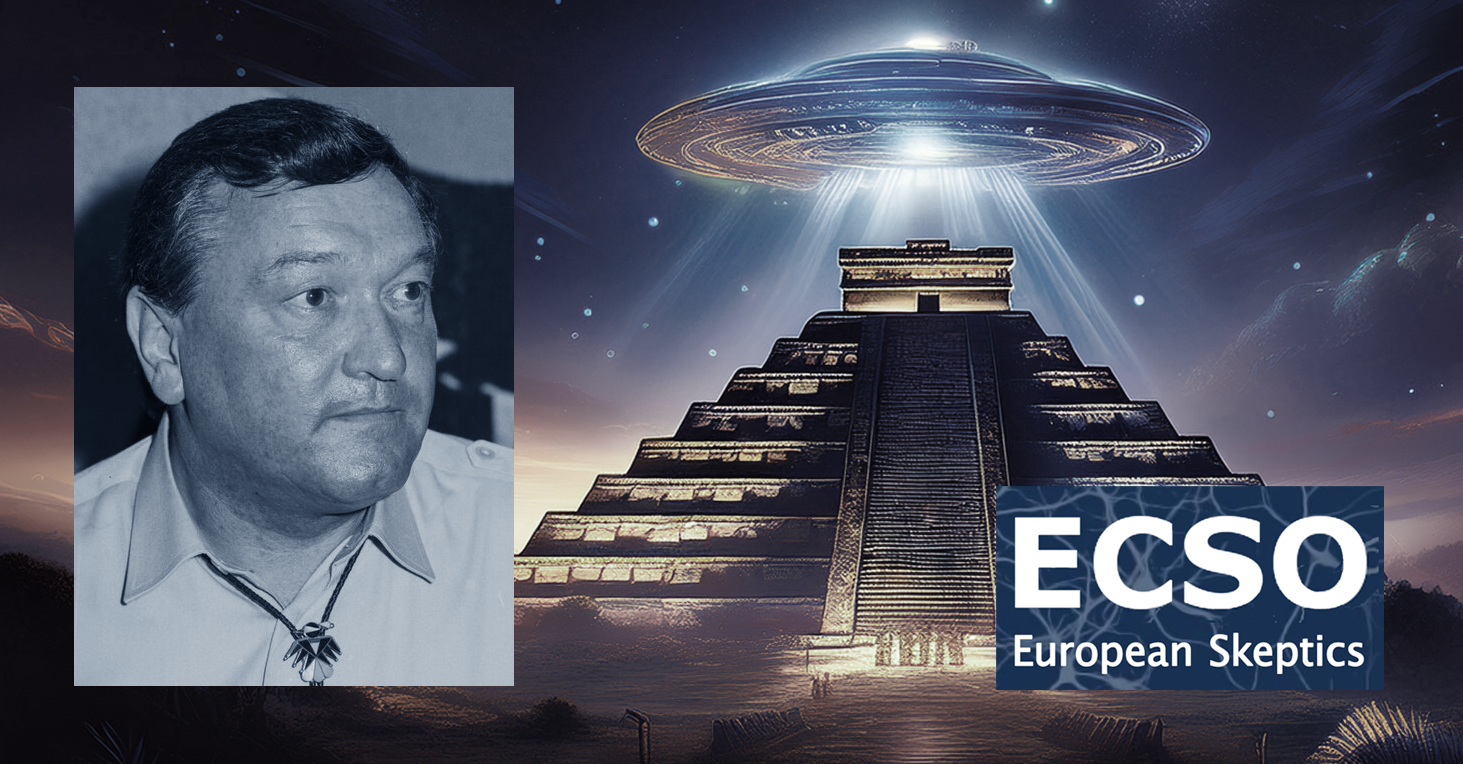
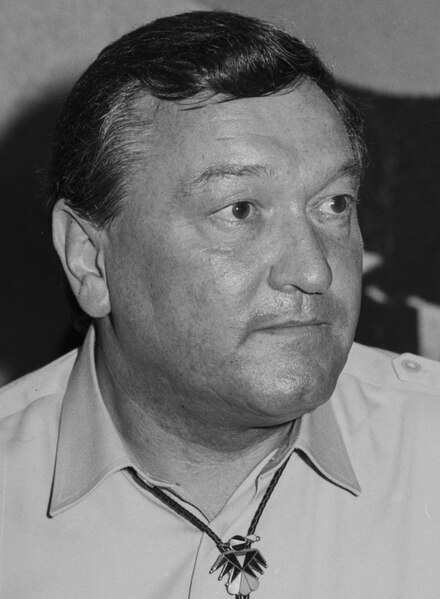
 Erich von Däniken passed away on January 10th. He was ninety years old. This Swiss hotelier became world-famous for promoting the idea that extraterrestrial beings visited us in the past and left traces of their presence on Earth. He wrote a total of 49 books, of which more than 70 million copies have been sold in dozens of languages. His last work was published in 2024.
Yet the essence of his message was already found in his very first work, Erinnerungen an die Zukunft. Ungelöste Rätsel der Vergangenheit (1968, English translation Chariots of the Gods? Unsolved Mysteries of the Past). The English title perfectly captures that essence: for our ancestors, the extraterrestrial beings who visited the Earth with their superior technology were regarded and worshipped as gods. Von Däniken, therefore, saw aliens everywhere, in ancient myths, in the Bible, and in primeval statues and murals. The fact that he was not hampered by a lack of scientific expertise did not bother him. On the contrary, as an absolute amateur, he took the position of underdog by asserting things that “established science” dared not acknowledge. Meanwhile, he travelled the world to find evidence for his view in ruins and archaeological sites. He knew nothing of archaeology, and what he wrote about science was often completely inaccurate, as far as it was understandable. Nevertheless, he behaved like he was a scientist and always expected recognition for his theory.
His theory wasn’t really new, and he was quickly accused of plagiarism. This didn’t stop him from being very successful and attracting followers. A documentary based on his first book was even nominated for an Oscar. It’s not easy to explain this success, but Chariots of the Gods? appeared at the end of the Golden Sixties, when space travel was booming, shortly before the first manned moon landing. In that spectacular era, anything seemed possible, so his book seemed quite credible to a wide audience. Von Däniken was perhaps the author who published on the right topic with the right tone at the right time.
Erich von Däniken continued to promote his ideas for the rest of his life. After a few decades, when the topic seemed somewhat trite, interest in his theory returned at the beginning of this century, indeed partly due to the excruciatingly absurd television series “Ancient Astronauts,” in which he featured prominently. Near his hometown of Interlaken, Switzerland, he founded a theme park that reflected his ideas, but this wasn’t a great financial success. The park – described by a Swiss scientist as a “scientific and cultural Chernobyl” – was sold last year. In Switzerland, an Ancient Astronauts Society and an Erich von Däniken Foundation continue his “work”.
Apart from the enormous amount of nonsense and errors that can be found in his books, Dutch historian of antiquity Jona Lendering saw two fundamental issues with von Däniken’s work. First, he denied the human creativity of virtually all past cultures. According to him, our ancestors were incapable of building the pyramids, the statues of Rapa Nui (Easter Island), Stonehenge, etc., themselves, so these constructions must have been the work of extraterrestrial technology. Second, for many people, he is the most important author on ancient civilizations. His readers see these civilizations through the lens he presents to them, “with an archaeology without method, full of exciting stories but intellectually meaningless”. All this while serious books on this subject receive far less attention.
Indeed, Erich von Däniken changed our view of the past. Thanks to him, the whole world knows Pacal’s tomb in Palenque, the ruins of Tiuhuanaco, the Nazca Lines, the rock carvings of Val Canonica, the Piri Reis map… It’s hard to visit them without reflecting on his views on them, even if we know they’re wrong. Any skeptic who visits Rapa Nui or opens the book of Ezekiel will still be reminded of von Däniken’s opinion. And that is likely to be the case for some time.